

How Long Is Tales Of Symphonia
| Tales of Symphonia | |
|---|---|
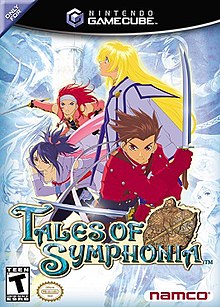 Northward American box fine art | |
| Developer(s) | Namco Tales Studio Other Ocean Interactive (Windows port) |
| Publisher(s) | Namco |
| Manager(south) |
|
| Producer(southward) | Makoto Yoshizumi |
| Designer(s) | Takashi Hasegawa |
| Artist(south) | Kōsuke Fujishima |
| Writer(s) | Takumi Miyajima |
| Composer(southward) |
|
| Series | Tales |
| Platform(s) | GameCube, PlayStation 2, PlayStation iii, Microsoft Windows |
| Release | GameCube
|
| Genre(southward) | Action role-playing game |
| Way(s) | Single-role player, multiplayer |
Tales of Symphonia (Japanese: テイルズ オブ シンフォニア, Hepburn: Teiruzu Obu Shinfonia ) is an action office-playing game released for the Nintendo GameCube on August 29, 2003, in Japan. It was published by Namco and is the fifth cadre product of the Tales series. The game was localized and released in North America on July 13, 2004, and in Europe on November 19, 2004.[1] In Japan, the game was ported for the PlayStation 2 with additional content and was released on September 22, 2004.[ii]
The game takes place in a fictional globe called Sylvarant and follows Lloyd Irving. Lloyd accompanies his childhood friend, Colette Brunel, who is destined to go along a journey to salve their globe. As their journey progresses, they learn that saving Sylvarant endangers Tethe'alla, a world parallel to their own. The game's central theme is an "RPG that resonates with you" ( 君と響きあうRPG , Kimi to Hibikiau RPG ).[3]
The game'southward reception was by and large positive. Information technology received a Nihon Game Awards in 2003 and had received re-releases nether the Role player'due south Choice and PlayStation 2 the Best labels.[4] [5] [6] In the United States, over 100 1000 copies were sold during the offset two weeks and has sold 2.iv million copies worldwide across all platforms, making it the best-selling title in the franchise.[7] [8] [9] The game has been adapted into seven manga collections, two novel series, seven drama CDs, and an OVA anime series. A sequel entitled Tales of Symphonia: Dawn of the New World was released for the Wii in 2008.[x] Tales of Symphonia and its sequel were collected as a PlayStation 3 high definition release in Tales of Symphonia Chronicles in 2013.[11] A Steam version was released on February two, 2016.[12]
Gameplay [edit]
Like previous installments in the Tales series, Tales of Symphonia consists primarily of 3 major areas: an overworld field map, town and dungeon maps, and a battle screen.[thirteen] The overworld map is a 3D model, featuring a scaled-down version of the game'south fictional earth which the player travels through to attain the game's locations. As with preceding games in the series, the world map tin can be traversed by foot, on the party'south quadrupedal pet Noishe, and on flying vehicles known equally Rheairds. On field maps, characters are directed across realistically scaled environments.[13] The battle screen is a 3D representation of an surface area, in which the player commands the characters in battles against CPU-controlled enemies.[14]
On the overworld and field maps, various skits between the characters can be viewed.[13] They involve blithe character portraits, subtitles, and, in the Japanese version, total vocalization acting. Skits business organisation anything from character development to side details. Overworld map skits affect Lloyd'due south relationships with other political party members. The actor will be able to make certain decisions that imperceptibly affect how the other characters recall of Lloyd. Some of these choices have modest ramifications for the game's storyline.[13]
- Battle system
During boxing sequences, the game uses the Multi-Line Linear Motion Battle Organisation.[14] [15] Four characters from the political party are chosen to battle; those non controlled by a histrion are guided past bogus intelligence with instructions set by the thespian beforehand. Impairment dealt to the opponent fills a "Unison Judge". When this is total, a "Unison Attack" tin can be triggered, allowing the party to use techniques simultaneously on a unmarried enemy. When certain techniques are combined, a special attack results in additional damage.[fourteen]
After boxing, a currency called Grade is awarded or subtracted based on specific criteria that are fulfilled in battle.[14] Information technology is used to purchase bonuses during New Game Plus. Players are also prompted to melt food after battles if they have the materials. Cooking recipes determine the benefits received such as wellness recovery. The degree of the do good is determined by which character is chosen to cook.[sixteen]
Tales of Symphonia 'southward skill system is built around the use of "EX Gems", which come up in four ranks.[17] Each graphic symbol can equip upwardly to iv EX Gems and set abilities to those gems. The abilities determine if the characters volition learn Strike or Technical techniques and spells. Combinations of EX Precious stone abilities tin can also grant additional abilities called "EX-Skills".[17] The development of a character's attributes is adamant by their equipped "Championship".[18] Titles are earned through story progression, side quests, or completion of miscellaneous criteria.[18]
Plot [edit]
Lloyd Irving and his friend, Genis Sage back-trail the chosen, Colette Brunel and her guardians, Raine Sage and Kratos Aurion on her journey of earth regeneration. The purpose of the journeying is to furnish Sylvarant with mana, a necessary energy to their survival.[NGC 1] The path of the journey consists of five temples which must be unsealed by Colette. On their journey, they meet Sheena Fujibayashi who comes from Tethe'alla, a globe parallel to Sylvarant. She tells them nearly how the two worlds vie for each other'due south mana through the journey of regeneration.[NGC 2] Hoping to discover answers from the angel Remiel, the political party meets him at the final seal and are betrayed by Remiel and Kratos; both are revealed to be function of Cruxis, an evil organization led by Mithos Yggdrasill.
The party leaves for Tethe'alla to search for a way to save both worlds and are joined by Zelos Wilder, Presea Combatir, and Purple Bryant. The party learns that awakening the Summon Spirits in both worlds volition sever the mana tie between them.[NGC 3] Believing that to be the answer, they successfully sever all mana ties between the two worlds.[NGC 4] Their deportment instead destabilize the Great Seed, the supplier of mana to both worlds, causing it to grow and engulf Sylvarant at an exponential charge per unit.[NGC v] After the party re-stabilizes the seed, they learn from Yuan Ka-Fai about the origins of Sylvarant and Tethe'alla and how they used to be one earth but was split by Mithos with the Eternal Sword; the party realizes they tin can relieve the world if they wield the Eternal Sword, merge the worlds, and germinate the Great Seed. They decide to face up and defeat Mithos earlier seeking the Eternal Sword.
Kratos is revealed to take been gathering materials to have Lloyd use the Eternal Sword. He succeeds just Mithos survives his apparent expiry and possesses a fellow member from the party earlier fleeing to the comet Derris-Kharlan. Mithos attempts to accept the Great Seed with him but is foiled and killed by Lloyd. Using the Eternal Sword, Lloyd merges Sylvarant and Tethe'alla together and germinates the Neat Seed into a Behemothic Kharlan Tree to supply the globe with mana.[NGC half dozen]
Development and release [edit]
The game was first appear on May 8, 2002, by Namco to exist ane of the many titles information technology would be releasing on the Nintendo GameCube.[nineteen] Namco stated it would be a part of the Tales of Phantasia series and expected comics, animation, drama CDs and novels to be spun off from the game.[19] Its proper noun was revealed to exist Tales of Symphonia in February 2003.[xx] An April 2003 edition of Famitsu revealed the game has been in development for ii years, its developers are the aforementioned from Tales of Eternia, the game will have the most main characters in the Tales series, and will exist the first 3D game in the series.[21] During Electronic Entertainment Expo 2003, a North American localization was confirmed.[22] A briefing by Namco on June 9, 2003, revealed the game volition be on two disks and its theme song will be "Starry Heavens" past Day After Tomorrow, which is remixed as "Starry Heavens ver. 2013", based on the orchestra version, which is too performed by the ring'southward lead vocaliser, Misono, in the PS3 version in both the Japanese and Western releases, too as the PC version.[23] To gloat its release in Japan, the game was arranged with a symphonic green Nintendo GameCube.[24] For the Northward American version, the localization producer replaced Starry Heavens with an orchestral canticle and focused on hiring professional vocalization actors to dub the game in order to entreatment to the Western audience.[25] [26] The game was released in Japan on August 29, 2003, and was localized in Northward America and Europe on July 13, 2004, and November xix, 2004, respectively.[1] The game was re-released in Northward America under the Player's Choice label on July 19, 2004.[5]
During the 2nd calendar week of April 2004, Weekly Shōnen Jump announced a PlayStation 2 port of Tales of Symphonia.[27] It received new in-game additions and its theme song is "Soshite Boku ni Dekiru Koto" ( そして僕にできるコト , lit. "And Thus, I Tin can Do Information technology") by Day After Tomorrow, which is also remixed as "Soshite Boku ni Dekiru Koto ver. 2013" ( そして僕にできるコト ver.2013 , lit. "And Thus, I Can Do It ver. 2013"), which is besides performed by the band's lead singer, Misono, in the PS3 version in both the Japanese and Western releases, likewise as the PC version.[28] [29] It was released exclusively in Japan on September 22, 2004, and re-released under the PlayStation two the Best label on July 7, 2005.[ii] [6]
Scenario [edit]
Takumi Miyajima, the game'due south writer, explained Tales of Symphonia was planned to create a "unique symphonia", dependent on the player's choices and the amore system.[30] Miyajima wrote many scenarios, with the well-nigh meaning events centered on Zelos Wilder. Originally, Zelos' death was supposed to be canon. His survival would take been dependent on the amore organization: He would dice early on if he was ranked the lowest in the affection organization, would dice at the end if he ranked in the eye, and would only survive if he ranked the elevation. Notwithstanding, the evolution staff suggested to have Kratos Aurion return to the political party and the squad discussed how it would piece of work. The change in scenario had Miyajima rework Zelos' death into a non-canon path of the story.[30] While generally a self-contained story, Symphonia apparently takes place within either the same or a similar timeline to the first Tales game, Tales of Phantasia.[31]
Sequel and Chronicles release [edit]
The sequel Tales of Symphonia: Knight of Ratatosk ( テイルズ オブ シンフォニア ラタトスクの騎士 , Teiruzu Obu Shinfonia Ratatosuku no Kishi ), localized in English language as Tales of Symphonia: Dawn of the New Globe, was announced on July xx, 2007, for the Wii.[32] Information technology was released in Japan and N America in 2008 and in Europe a twelvemonth after.[10]
Tales of Symphonia Chronicles was appear on June one, 2013, for the PlayStation three.[xi] It contains Tales of Symphonia and Tales of Symphonia: Dawn of the New World with remastered graphics and boosted content.[xi] It was released in Japan on October x, 2013, and it was released in North America and Europe in February 2014 as both a retail version and download release, with the choice to buy Tales of Symphonia as a standalone release.
Adaptations [edit]
Comics [edit]
Tales of Symphonia spawned vii manga adaptations afterward its release: six anthology collections and a traditional manga series.
The starting time anthology collection, Tales of Symphonia Comic Anthology [kanji ane], consists of five volumes which were released between November 25, 2003, and Feb 25, 2006, by Ichijinsha.[33] [34] The second album collection, Tales of Symphonia Yonkoma Kings [kanji 2], is a iv-panel comic. It consists of 5 volumes released between November 25, 2003, and December 25, 2006, by Ichijinsha. A third anthology drove entitled BC Anthology Collection Tales of Symphonia [kanji 3] had two volumes published past Magazine Garden in February 2005 and 2007. The fourth anthology collection is BC Anthology Collection Tales of Symphonia Yonkoma Curt Comic Collection [kanji 4] and consisted of a single book which was released past Mag Garden on October 10, 2007. The fifth anthology collection is Super Comic Theater: Tales of Symphonia [kanji 5]. It consisted of two volumes which were released by Square Enix on May 27, 2005, and September 16, 2005.[33] The 6th anthology drove is Tales of Symphonia Comic Anthology: The Best [kanji 6] is a single book released on June 5, 2010, by Ichijinsha.[35]
The manga series by Hitoshi Ichimura was titled Tales of Symphonia and was an adaptation of the game's storyline.[33] The first 4 chapters were serialized between the April and July 2005 editions of Monthly Comic Blade.[36] [37] [38] [39] Time to come chapters were released in tankōbon volumes by Mag Garden thereafter. Six volumes were released: the offset was released on August ten, 2005, and the concluding 2 were released on July 10, 2007.[33]
Books [edit]
Tales of Symphonia has spun off two novel series adaptions, four strategy guides, a character book, an official scenario book, and an art book. The first novel serial is titled Tales of Symphonia and is written by Kiyoshi Yuki.[33] It consisted of three novels released between November 21 and Dec 20, 2003, by Shueisha. The second novel series is titled Tales of Symphonia: Radiance of Time ( テイルズ オブ シンフォニア 久遠 の輝き , Teiruzu Obu Shinfonia Toki no Kagayaki ) and is written past Sera Yajima. It consists of four volumes released between December 20, 2003, and June xix, 2004, by Enterbrain. An after story by the same writer was released on September xviii, 2004.[33]
Ii strategy guides under the 5 Leap Books make were published by Shueisha: the Gamecube guide was released on August 29, 2003, and the PS2 on September 22, 2004.[33] Namco Bandai Games released ii official strategy guides on Oct 1, 2003, and October 27, 2004, for the Gamecube and PS2 respectively.[33] Tales of Symphonia Illustration: Kosuke Fujishima's Character Work [kanji 7] is a book by the game's designer, Kōsuke Fujishima, and was released on January 26, 2004, past Ichijinsha. It provides details on the characters' dorsum story and how their design came to be. Tales of Symphonia Official Scenario Book [kanji eight] was released on June 26, 2008, past Namco Bandai. The book details the history of the globe and characters. Tales of Symphonia The Animation Visual Complete Picture Book [kanji 9] is an art book for the anime released on March 28, 2013, by ASCII Media Works.[33]
Sound CDs [edit]
7 drama CDs based on the game's plot were produced by Frontier Works.[40] Drama CD: Tales of Symphonia (A Long Time Ago) [kanji 10] 1, ii, and 3 are stories preceding the game. They were released between July 23, 2004, and September 24, 2004. Drama CD: Tales of Symphonia Album 1 (Rodeo Ride Tour) [kanji 11] First Part and Second Office follow Sheena Fujibayashi and Zelos Wilder as they tour the world a yr afterwards the events of the chief game. The two CDs were released on May 25, 2005, and June 24, 2005. Tales of Symphonia Comic Market 78 [kanji 12] and Tales of Symphonia Comic Market 79 [kanji xiii] are side stories with invitee characters from Tales of Vesperia and Tales of Graces, respectively.[twoscore]
Tales of Symphonia Original Soundtrack [kanji 14] was published by DigiCube on October 1, 2003, and consists of 4 discs. It debuted at 98 on Oricon's charts.[41] The soundtrack was re-released on Oct 27, 2004, by Rex Records (Japan) for the PS2 port of Tales of Symphonia.[40]
Animation [edit]
| Tales of Symphonia | |
| Original video animation | |
| Tales of Symphonia The Animation: Sylvarant Episode | |
|---|---|
| Directed by | Haruo Sotozaki |
| Produced past |
|
| Written by | Ryunosuke Kingetsu |
| Music past | Zizz Studio |
| Studio | Ufotable |
| Licensed by | NA Discotek Media (streaming) |
| Released | June 8, 2007 – December 21, 2007 |
| Runtime | 32–34 minutes (each) |
| Episodes | iv |
| Original video animation | |
| Tales of Symphonia The Animation: Tethe'alla Episode | |
| Directed by | Haruo Sotozaki |
| Produced past |
|
| Written by | Ryunosuke Kingetsu |
| Music past | Zizz Studio |
| Studio | Ufotable |
| Licensed by | NA Discotek Media (streaming) |
| Released | March 25, 2010 – February 25, 2011 |
| Runtime | 40–46 minutes (each) |
| Episodes | 4 |
| Original video animation | |
| Tales of Symphonia The Animation: The United World Episode | |
| Directed past | Haruo Sotozaki |
| Produced by |
|
| Written past | Ryunosuke Kingetsu |
| Music by | Zizz Studio |
| Studio | Ufotable |
| Licensed by | NA Discotek Media (streaming) |
| Released | November 23, 2011 – October 23, 2012 |
| Runtime | 33–47 minutes (each) |
| Episodes | 3 |
Tales of Symphonia The Animation ( テイルズ オブ シンフォニア The Animation , Teiruzu Obu Shinfonia The Animation ) was an OVA series animated by Ufotable and produced by Geneon Universal Entertainment and Borderland Works.[42] It consists of four episodes which were released direct-to-video on four separate DVDs on June viii, August x, October 24, and December 21 of 2007.[43] They were later released in a Blu-ray Disc collection on September 26, 2008.[44] The serial after rereleased on Universal Media Disc between June 25 and July 23, 2010.[45] On May eight, 2010, the serial were aired on AT-X as a promotion to the sequel of the series.[46] The episodes used three pieces of theme music: The opening theme is "Almateria" by Eri Kawai and the two ending themes were "Negai" ( 願い , lit."Wish") past Kaori Hikita and Uchi e Kaerou ( うちへ帰ろう , lit. "Permit'southward Become Dwelling house") by Nana Mizuki.[44] [47]
The sequel serial, Tales of Symphonia the Animation: Tethe'alla Episode ( テイルズ オブ シンフォニア The Blitheness テセアラ編 , Teiruzu Obu Shinfonia The Animation: Teseara hen ), was announced during Tales of Festival 2008.[48] It consists of 4 episodes which were released on March 25, May 26, September 23, 2010, and February 25, 2011.[49] All iv episodes received an early on screening: The first was screened on March xiii, 2010, in Fukuoka and was hosted by Music Plaza Indo;[50] The second on May 4, 2010, in Tokushima, Tokushima by Ufotable;[51] the third on September 17, 2010, in Yokohama past Animate;[52] and the quaternary on Feb 20, 2011, in Roppongi by Toho.[53] The starting time two episodes were afterward aired on September 12, 2010, on AT-X.[54] The episodes used the opening theme "Tenkuu no Canaria" ( 天空のカナリア , lit."Canary in the Sky") by Nana Mizuki and the ending theme "Inori no Kanata" ( 祈りの彼方 , lit."Beyond the Prayers") by Akiko Shikata.[55] Ending theme of the fourth episode is "Tethe'alla: Tsui no Kodomo-tachi" ( 対の子どもたち ) past Akiko Shikata.
The second sequel, Tales of Symphonia the Animation: The United World Episode ( テイルズ オブ シンフォニア The Blitheness 世界統合編 , Teiruzu Obu Shinfonia The Blitheness: Sekai Tōgō-hen ), concludes the anime's plot. It consists of three episodes released directly to DVD and Blu-ray on November 23, 2011, June 20, 2012, and October 24, 2012.[45] [56] All three episodes had early screenings: the starting time was screened between September 23 and September 25, 2011, by Cinema Sunshine in Ikebukuro;[57] the 2d on May 3, 2012, in Tokushima by Ufotable;[58] and the third is on September 29, 2012, by Picture palace Sunshine in Ikebukuro.[59] The episodes use four pieces of theme musics: an opening theme "Ho-n-to-u-so" ( ホ・ン・ト・ウ・ソ , lit. "Truth and Lies") past Misono and 3 catastrophe themes, "Ta ga Tame no Sekai" ( 誰ガ為ノ世界 , lit. "A World for Someone Else"), "Ibitsu" ( 歪 , lit. "Distortion"), and "Hikari furu basho de ~Promesse~" ( 光降る場所で~Promesse~ , lit. "At the Identify Where the Light Falls ~Hope~"), all by Akiko Shikata.[55]
A Blu-ray box ready containing all three serial was appear on June 1, 2013, and released on November vi, 2013.[60]
Reception [edit]
Tales of Symphonia garnered generally positive reception from critics. Over 100,000 copies were sold in the United States during the first two weeks after its release.[8] In December 2007, Namco announced that the GameCube version had sold 953,000 copies worldwide, and the PlayStation 2 port had sold 486,000 copies in Japan.[9] The deal reissue for the PlayStation ii in 2005 sold virtually 50,000 copies in Japan by the cease of 2006.[79] Its total worldwide sales for the GameCube and PS2 take reached 1.half dozen one thousand thousand units as of 2008, making it the all-time-selling Tales title to date. It was also the best-selling Tales title overseas, with more than half of its sales coming from outside Japan, having sold 600,000 units in North America and 250,000 in Europe as of 2008[update].[lxxx] The 2016 PC release sold more than than 250,000 copies on Steam, as of Apr 2018[update].[81] The game is estimated to have sold 2.4 one thousand thousand copies worldwide beyond all platforms, making it the best-selling title in the franchise.[vii]
Critics take praised the game for its cel-shaded art fashion and real-fourth dimension battle organization. 1UP, GameSpot, GameSpy, IGN and X-Play applauded the amount of detail in the scenes, with GameSpy noting the steady 60 frames per second.[lxx] [73] [71] [62] [77] GameSpy described the battle organisation as "wonderfully fast and to the point" while X-Play noted its accessibility and potential to attract non-RPG gamers.[71] [77] The story and audio received a more than mixed reception, with Border, GamePro, Nintendojo, Thunderbolt, PALGN, Eurogamer and Planet GameCube praising the story and characters for being either charming, engaging, practiced, or enjoyable,[61] [76] [66] [75] while GameSpot, GameSpy, IGN and 10-Play criticized the plot for being either cliché or un-engaging.[70] [73] [71] [77] The reviewers agreed that the music and English language voices met standards. GameSpy and X-Play additionally praised the graphic symbol interactions for being likeable.[71] [77]
GameSpot named information technology the best GameCube game of July 2004,[82] and nominated it for the year-stop "Best Office-playing Game" laurels across all platforms.[83] The game has appeared on many tiptop game rankings and received a Japan Game Awards in 2003 for excellence.[4] The Jan 2009 issue of Game Informer listed it at #24 in its "Elevation 25 GameCube Games".[84] Nintendo Power ranked Tales of Symphonia 107th in a listing of "Top 200 Nintendo Games Ever".[85] IGN users placed it 75th in a Tiptop 100 Games list,[86] while GameFAQs users put it at 81st in a like list.[87]
Notes and references [edit]
Notes [edit]
- ^ テイルズ オブ シンフォニア コミックアンソロジー , Teiruzu Obu Shinfonia Komikku Ansorojī
- ^ テイルズ オブ シンフォニア コミックア 4コマ Kings , Teiruzu Obu Shinfonia Yonkoma Kings
- ^ BCアンソロジーコレクション テイルズ オブ シンフォニア , BC Ansorojī Korekushon Teiruzu Obu Shinfonia
- ^ BCアンソロジーコレクション テイルズ オブ シンフォニア 4コマ・ショートコミックセレクション , BC Ansorojī Korekushon Teiruzu Obu Shinfonia Yonkoma: Shōto Komikku Serekushon
- ^ スーパーコミック劇場 テイルズ オブ シンフォニア , Sūpā Komikku Gekijou Teiruzu Obu Shinfonia
- ^ テイルズ オブ シンフォニア コミックアンソロジー The Best , Teiruzu Obu Shinfonia Komikku Ansorojī The Best
- ^ テイルズ オブ シンフォニア イラストレーションズ 藤島康介のキャラクター仕事 , Teiruzu Obu Shinfonia Irasutorēshonzu Fujishima Kōsuke no Kyarakutā Shigoto
- ^ テイルズ オブ シンフォニア 公式シナリオブック , Teiruzu Obu Shinfonia Koushiki Shinario Bukku
- ^ テイルズ オブ シンフォニア The Animation ビジュアルコンプリートブック , Teiruzu Obu Shinfonia The Blitheness Bijua Rukon Purīto Bukku
- ^ ドラマCD テイルズ オブ シンフォニア 〜A long time agone〜 , Dorama CD Teiruzu Obu Shinfonia 〜A long time agone〜
- ^ ドラマCD テイルズ オブ シンフォニア アンソロジー1 〜ロデオライド・ツアー〜 , Dorama CD Teiruzu Obu Shinfonia Ansorojī 1 (Rodeoraido Tsuā)
- ^ テイルズリング・シンフォニア Comic Market 78
- ^ テイルズリング・シンフォニア Comic Market place 79
- ^ テイルズ オブ シンフォニア オリジナル・サウンドトラック , Teiruzu Obu Shinfonia Orijinaru Saundotorakku
References [edit]
- ^ a b "Tales of Symphonia Release Dates". GameSpot. Archived from the original on August xvi, 2012. Retrieved May 2, 2012.
- ^ a b "Symphonia to include Tales of Rebirth preview". GameSpot. Retrieved February 8, 2015.
- ^ "Tales of Symphonia Official PS2 Website" (in Japanese). Namco Bandai Games. Retrieved May ane, 2012.
- ^ a b c "Nihon Game Awards 2003–2004". Estimator Entertainment Supplier's Clan. Archived from the original on Feb 14, 2012. Retrieved May 20, 2012.
- ^ a b "Tales of Symphonia (Actor'south Pick)". Play-Asia. Retrieved May twenty, 2012.
- ^ a b Niizumi, Hirohiko (June 2, 2005). "Sony adding new budget reissues". GameSpot. Retrieved May 20, 2012.
- ^ a b "Tales of Arise reaches 1.5 million sold milestone". 28 Oct 2021.
- ^ a b Preziotte, Mathew (Baronial 16, 2004). "July 2004 Sales Figures for America". Nintelligent Network. Archived from the original on Feb 22, 2005. Retrieved May i, 2012.
- ^ a b "Tales series exceeds 10 million copies" (PDF) (in Japanese). Namco Bandai Games. Dec 11, 2007. Retrieved May ane, 2012.
- ^ a b "Tales of Symphonia: Dawn of the New Globe release appointment". GameSpot. Archived from the original on June ane, 2013. Retrieved May 17, 2012.
- ^ a b c "Tales of Symphonia Chronicles Confirmed for Overseas Release in 2014". Anime News Network. June 1, 2013. Retrieved June 1, 2013.
- ^ "Zestiria Collector's Edition revealed and preorder Symphonia for PC". Tales Of. July 2, 2015. Archived from the original on July 3, 2015. Retrieved July 2, 2015.
- ^ a b c d Tales of Symphonia North American instruction transmission. Namco. 2003. pp. 10–11.
- ^ a b c d Tales of Symphonia North American instruction manual. Namco. 2003. pp. 27–34.
- ^ "Tales of Symphonia Hands-On". IGN. Baronial 29, 2003. Retrieved May 13, 2012.
- ^ Tales of Symphonia North American instruction transmission. Namco. 2003. p. 24.
- ^ a b Tales of Symphonia North American instruction manual. Namco. 2003. pp. 22–23.
- ^ a b Tales of Symphonia North American instruction transmission. Namco. 2003. pp. 18–19.
- ^ a b "Namco Brings GCN Back up". IGN. May 8, 2002. Retrieved May 13, 2012.
- ^ "GameCube in 2003: Part 2". IGN. February twenty, 2003. Archived from the original on June 14, 2006. Retrieved May 13, 2012.
- ^ "Weekly Japanese Mag Study". IGN. April nine, 2003. Retrieved May 13, 2012.
- ^ "E3 2003: Tales of Symphonia U.s. Bound". IGN. May 9, 2003. Retrieved May 13, 2012.
- ^ "New Tales of Symphonia Details". IGN. June 9, 2003. Retrieved May 13, 2012.
- ^ "Tales of Symphonia GCN Packet". IGN. July 11, 2003. Retrieved May 13, 2012.
- ^ "Pre-E3 2004: Tales of Symphonia Interview Page 2". IGN. April 30, 2004. Retrieved May 13, 2012.
- ^ "Tales of Symphonia FAQ Page four". IGN. June eleven, 2004. Retrieved May 13, 2012.
- ^ Hitmitsu, Suppai (April four, 2004). "New Tales Games for PS2". IGN. Retrieved May 13, 2012.
- ^ "Tales of Symphonia PS2 Theme Song". Namco Bandai Games. Retrieved May xiii, 2012.
- ^ "Tales of Symphonia PS2 Additions". Namco Bandai Games. Retrieved May xiii, 2012.
- ^ a b Viva Tales of (in Japanese). 2013 (November).
- ^ 「テイルズオブシンフォニア イラスト集」 藤島康介のキャラクター仕事 [Kosuke Fujishima Character Works: Tales of Symphonia Illustrations] (in Japanese). Studio DNA. 26 Jan 2004. p. 60. ISBN978-4758010191.
- ^ Gantayat, Anoop (July twenty, 2007). "Tales Set for Wii, DS". IGN. Retrieved June 2, 2013.
- ^ a b c d due east f g h i "Tales of Symphonia book releases" (in Japanese). Namco Bandai Games. Archived from the original on Baronial thirty, 2011. Retrieved May 15, 2012.
- ^ "Tales of Symphonia volume releases page two" (in Japanese). Namco Bandai Games. Archived from the original on May xv, 2012. Retrieved May xv, 2012.
- ^ "Tales of Symphonia Comic Anthology: The All-time" (in Japanese). Ichijinsha. Archived from the original on November 4, 2013. Retrieved March 15, 2013.
- ^ "Monthly Comic Blade April 2005 consequence" (in Japanese). Magazine Garden. Archived from the original on March 4, 2005. Retrieved May 15, 2012.
- ^ "Monthly Comic Blade May 2005 issue" (in Japanese). Mag Garden. Archived from the original on Apr half dozen, 2005. Retrieved May 15, 2012.
- ^ "Monthly Comic Blade June 2005 issue" (in Japanese). Mag Garden. Archived from the original on May 7, 2005. Retrieved May fifteen, 2012.
- ^ "Monthly Comic Bract July 2005 issue" (in Japanese). Mag Garden. Archived from the original on June 9, 2005. Retrieved May xv, 2012.
- ^ a b c "Tales of Symphonia CD releases" (in Japanese). Namco Bandai Games. Archived from the original on March 17, 2013. Retrieved May 16, 2012.
- ^ "Tales of Symphonia Original Soundtrack" (in Japanese). Oricon. Archived from the original on November 11, 2012. Retrieved May 16, 2012.
- ^ "Tales of Symphonia The Animation Sylvarant staff" (in Japanese). Namco Bandai Games. Archived from the original on November 27, 2010. Retrieved May 13, 2012.
- ^ "Tales of Symphonia The Blitheness Sylvarant DVDs" (in Japanese). Frontier Works. Archived from the original on February 14, 2008. Retrieved May thirteen, 2012.
- ^ a b "Tales of Symphonia The Animation Sylvarant releases" (in Japanese). Namco Bandai Games. Archived from the original on November xvi, 2012. Retrieved May 13, 2012.
- ^ a b "Tales of Symphonia The Animation: United World Episode products" (in Japanese). Namco Bandai Games. Archived from the original on June 23, 2012. Retrieved June 26, 2012.
- ^ "Slyvarant Role circulate on AT-X" (in Japanese). Namco Bandai Games. May vii, 2010. Retrieved May 14, 2012.
- ^ Credits from Tales of Symphonia The Animation" Volume 3 (DVD). Geneon Universal Entertainment. October 24, 2007. FG-8008.
- ^ "Tales of Symphonia OVA Sequel Series Light-green-Lit". Anime News Network.com. September 24, 2008. Retrieved Baronial 19, 2009.
- ^ "Tales of Symphonia the Animation: Tethe'alla Episode guide" (in Japanese). Animate. Archived from the original on April 17, 2012. Retrieved May 14, 2012.
- ^ "Tethe'alla volume 1 screening on March 13, 2010, in Fukuoka" (in Japanese). Namco Bandai Games. March ten, 2010. Retrieved March three, 2013.
- ^ "Tethe'alla book two screening on May 4, 2010 in Tokushima" (in Japanese). Namco Bandai Games. March 10, 2010. Retrieved March three, 2013.
- ^ "Tethe'alla volume 3 screening on September 17, 2010 in Yokohama" (in Japanese). Namco Bandai Games. September 7, 2010. Retrieved March 3, 2013.
- ^ "Tethe'alla final volume screening on Feb twenty, 2010 in Roppongi" (in Japanese). Namco Bandai Games. Feb 7, 2011. Retrieved March iii, 2013.
- ^ "Tethe'alla episodes circulate on AT-X" (in Japanese). Namco Bandai Games. September 7, 2010. Retrieved May xiv, 2012.
- ^ a b "Tales of Symphonia The Animation staff" (in Japanese). Namco Bandai Games. Archived from the original on Apr 20, 2012. Retrieved May 13, 2012.
- ^ "United World volume iii delayed" (in Japanese). Namco Bandai Games. June 22, 2012. Retrieved March iii, 2013.
- ^ "United World volume screening on September 23–25 in Ikebukuro" (in Japanese). Namco Bandai Games. September 9, 2011. Retrieved March 3, 2013.
- ^ "United World volume 2 screening on May iii, 2012 in Tokushima" (in Japanese). Namco Bandai Games. May 3, 2012. Retrieved March 3, 2013.
- ^ "United World volume screening on September 29, 2012 in Ikebukuro" (in Japanese). Namco Bandai Games. September 28, 2012. Retrieved March 3, 2013.
- ^ "Tales of Symphonia Unisonant Pack announced". Anime News Network. June 1, 2013. Retrieved June 2, 2013.
- ^ a b "Tales of Symphonia for GameCube Reviews". Metacritic. Retrieved 25 January 2013.
- ^ a b Nutt, Christian (August 10, 2004). "1UP Tales of Symphonia review". 1UP.com. Archived from the original on October 19, 2012. Retrieved May 15, 2012.
- ^ "Tales of Symphonia". Calculator Games Magazine. October 2004. p. nine.
- ^ "Tales of Symphonia". Edge. October 2004. p. 106.
- ^ "Electronic Gaming Monthly Tales of Symphonia review". Electronic Gaming Monthly. No. 181. August 2004. p. 110.
- ^ a b Fahey, Rob (Nov ii, 2004). "Eurogamer Tales Of Symphonia Review". Eurogamer. Retrieved May 15, 2012.
- ^ "Tales of Symphonia reviews". IGN. Archived from the original on June 16, 2013. Retrieved July 22, 2012.
- ^ "Game Informer Tales of Symphonia review". Game Informer. No. 135. July 2004. p. 117.
- ^ Star Dingo (July xiii, 2004). "Tales of Symphonia Review for GameCube". GamePro. Archived from the original on 15 July 2004. Retrieved 5 May 2020.
- ^ a b c Massimilla, Bethany (July half-dozen, 2004). "GameSpot Tales of Symphonia review". GameSpot. Retrieved May 15, 2012.
- ^ a b c d e Turner, Benjamin (July 5, 2004). "GameSpy Tales of Symphonia review". GameSpy. Retrieved May xv, 2012.
- ^ "Tales of Symphonia". GamesTM. Oct 2004. p. 102.
- ^ a b c Irwin, Mary Jane (July 4, 2006). "IGN Tales of Symphonia review". IGN. Retrieved May 15, 2012.
- ^ "Nintendo Power Tales of Symphonia review". Nintendo Ability. No. 183. September 2004. p. 115.
- ^ a b "Reviews: Tales of Symphonia". Planet GameCube. NintendoWorldReport. July 11, 2004. Archived from the original on iii Baronial 2004. Retrieved 5 May 2020.
- ^ a b Jastrzab, Jeremy (2005). "Tales of Symphonia Review". PALGN. Archived from the original on 16 June 2005. Retrieved half-dozen May 2020.
- ^ a b c d east "Ten-Play Tales of Symphonia review". X-Play. September eight, 2004. Archived from the original on Jan 4, 2006. Retrieved May 15, 2012.
- ^ "Tales of Symphonia Rates High". IGN. August 19, 2003. Retrieved March 4, 2013.
- ^ "2006年ゲームソフト年間売上TOP500" [2006 Game Software Annual Sales Top 500]. Famitsū Gēmu Hakusho 2007 ファミ通ゲーム白書2007 [Famitsu Game Whitebook 2007] (in Japanese). Tokyo: Enterbrain. 2007. p. 387. ISBN978-iv-7577-3577-4. JPNO 21240454.
- ^ 特別インタビュー Xbox 360「テイルズ オブ ヴェスペリア」(前編). Print Watch. 14 April 2008. Archived from the original on xi July 2014. Retrieved two November 2012.
- ^ "TALES OF SYMPHONIA -". Steam Spy. Archived from the original on 2018-04-11. Retrieved vi May 2020.
- ^ Staff (August 10, 2004). "GameSpot 's Calendar month in Review for July 2004". GameSpot. Archived from the original on April 14, 2005.
- ^ The GameSpot Editors (Jan 5, 2005). "Best and Worst of 2004". GameSpot. Archived from the original on March 7, 2005.
- ^ Ben Reeves (September 22, 2009). "GameCube Top 25". Game Informer . Retrieved August 21, 2008.
- ^ "NP Peak 200". Nintendo Power. Vol. 200. February 2006. p. 63.
- ^ "IGN Peak 100 Games 2008 Reader's Option - 75: Tales of Symphonia". IGN. Archived from the original on March iii, 2013. Retrieved August 21, 2010.
- ^ "ten-Yr Anniversary Contest — The 10 Best Games Ever". GameFAQs. Retrieved October 4, 2006.
Principal references [edit]
Namco Tales Studio (July 13, 2004). Tales of Symphonia (Nintendo GameCube). Namco.
- ^ Raine: Today is the Solar day of Prophecy. It is a very important day, which the Chosen of Mana will receive an oracle from the Goddess Martel. At present, Chosen 1...Colette. Tell u.s. about the journeying of world regeneration. /Colette: It is a journeying to seal the Desians. Upon passing the trials of the Goddess Martel, the Summon Spirit that protect the world awaken, and mana is restored.
- ^ Sheena: My world is chosen Tethe'alla. [...] The two worlds lie directly adjacent to each other. They just can't run into one another. Our scholars say they exist on shifted dimensions. Anyway, the ii worlds tin't encounter or touch each other, but they do in fact exist next to and affect each other. [...] They vie for the supply of mana. When one earth weakens, the mana from that world flows to the other. Every bit a result, i world is e'er flourishing, and the other waning. Sort of like an hourglass. [...] Sylvarant's mana is flowing to Tethe'alla. Therefore, Sylvarant is in refuse. Without mana, crops won't grow and magic becomes unusable. If there is no mana, the Summon Spirits that protect the globe alongside the Goddess Martel can't survive in Sylvarant either. As a event, the globe slips even further downwards the path of destruction. /Raine: Then the Chosen's earth regeneration is actually the process of reversing the mana flow?/Sheena: Exactly. When the Chosen breaks the seal, the mana flow reverses, and the Summon Spirit that governs the seal awakens.
- ^ Undine: Mana flows from the earth in which the Summon Spirits slumber to the world in which the Summon Spirits are awake. This is the first time the Summon Spirits have been awakened in both worlds at the aforementioned time. Because of this, the mana connecting the two worlds has been eliminated.
- ^ Lloyd: Does that mean that Sylvarant and Tethe'alla accept stopped competing for each other's mana?/Volt: .../Raine:I do non know. The only affair certain is that the flow of mana between the worlds has been severed./Undine: Yes. Eventually the worlds shall carve up.../Genis: You lot mean the two worlds will split apart?/Zelos: That's perfect! Then they'll stop competing for each other's mana!
- ^ Kratos: Having lost the stability afforded past the protection of the Summon Spirits, the Great Seed has gone out of control. /Yuan: No! The purpose of the Summon Spirits was to isolate the Not bad Seed from the outside globe and preclude information technology from growing! /Kratos: That was simply one-half of information technology. The two worlds were forced out of phase by Yggdrasill. They should accept drifted apart from each other and have been consumed by the void. But this was prevented from happening because the Smashing Seed was placed in the center between the ii worlds. [...] The Keen Seed is constantly being pulled upon from both worlds as they attempt to separate from one some other. It's a miracle that this frail balance held up for even this long. /Yuan: Wait! So the mana links served as a cage to contain the Great Seed in the space betwixt the two worlds? Is that what you're saying? /Kratos: Exactly. And because yous provided the unstable Great Seed with mana, germinated in a twisted class and has gone out of control. Information technology'south fifty-fifty engulfed Martel. /Lloyd: Who cares why this happened! I wanna know what's gonna happen if we tin't end this matter!/Yuan: If what Kratos says is true, and then Sylvarant volition be consumed and destroyed by the Great Seed. And if Sylvarant is destroyed, Tethe'alla volition exist destroyed besides, as it is linked past the Holy Ground of Kharlan and the Otherworldly Gate.
- ^ Origin: The earth was originally separated into ii in society to prevent its destruction. If it returns to its true form, the world lacks the mana to support itself. The land is dying. /Lloyd: I don't need to know why it'south dying! What practise we demand to do to stop it?/Origin: Support the ii worlds past linking them with the Behemothic Tree. That is the only way to stop the destruction of the country. [...] Lloyd: This is my last wish. Eternal Sword [...] Rising Giant Kharlan Tree!
External links [edit]
- Official website (archived)
- Tales of Symphonia (PS2) Official website (JP)
- Tales of Symphonia Chronicles Official website (JP)
- Tales of Symphonia: The Animation (OVA) (anime) at Anime News Network'south encyclopedia
Source: https://en.wikipedia.org/wiki/Tales_of_Symphonia
0 Response to "How Long Is Tales Of Symphonia"
Post a Comment