

How To Make Apple Music Fade
iTunes and iOS devices offer a number of means to tweak the sound during playback. Yous can use an blaster to adjust certain frequencies, use Audio Check to normalize the volume of dissimilar tracks, and utilize Sound Enhancer to, well, enhance your sound. In that location's also Crossfade Songs, which lets you play songs then they segue from i into another. Here's what you can do to fiddle with your audio in iTunes and on your iOS device.
Equalization
Depending on how you listen to your music, y'all may want—or demand—to adjust the sound that comes out of your computer or your iOS device. If you have simple speakers continued to your computer or use an iMac's internal speakers, you might not have bass and treble adjustments bachelor. Even so for some music, you lot may desire to alter the overall sound by increasing or decreasing certain frequencies.
Changing the volume of sure frequencies to change the audio of music during playback is chosen equalization. Equalizers used to exist pretty mutual in loftier-end home audio systems back in the 1970s. These devices are still used for alive music mixing and for studio recording, just they've become rare in home sound, as many amplifiers include equalization features.
iTunes includes a graphic equalizer that lets you change the book of ten different frequency bands to alter your music, and, in many cases, improve the sound. To access the iTunes blaster, printing Control-Selection-E, or choose Window > Equalizer. If you're familiar with the way an equalizer works, y'all'll run into that the brandish of the Equalizer window is pretty much the same as a standalone graphic equalizer. Information technology has sliders that permit yous adjust the volume of each of its 10 bands; just drag them up or downwards.
However, many people don't know how to apply equalization. For this reason, the iTunes Blaster has 2 dozen presets, including Classical, Jazz, Rock, Bass Booster, Bass Reducer, Treble Booster, and Treble Reducer, and fifty-fifty ane called Beats. If you check the On box and choose one of those presets, your audio output will modify according to the frequency adjustments the preset contains.
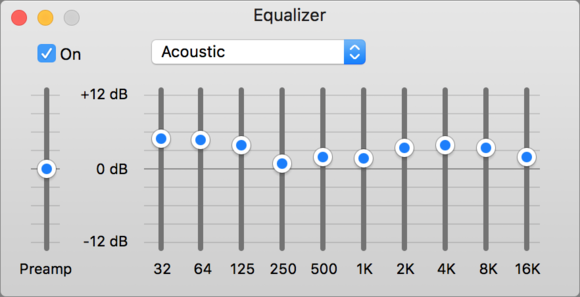
The iTunes Equalizer window.
Using an equalizer is hit or miss; in most cases, the "genre" presets won't piece of work with all the music of that genre since every recording is different. You lot will find that, say, Rock will make some rock music audio amend, because information technology enhances the bass and treble, and that the Dance setting, which enhances bass, might make dance music sound ameliorate. But in other cases, the music may audio dirty or tinny.
Equalization is more than designed to compensate for your environment (your room) and your playback equipment (your speakers). For example, if you lot detect that you get poor bass response, either because your speakers aren't bassy enough or your room dampens the bass, try using the Bass Booster preset. Or if you're using small speakers, such as an iMac'southward internal speakers, the Small Speakers preset might improve your audio. Yous can either utilize the equalizer for all your music or apply presets to specific songs or albums: to exercise the latter, select a vocal, press Command-I, click on the Options tab, and then choose an Equalizer Preset.
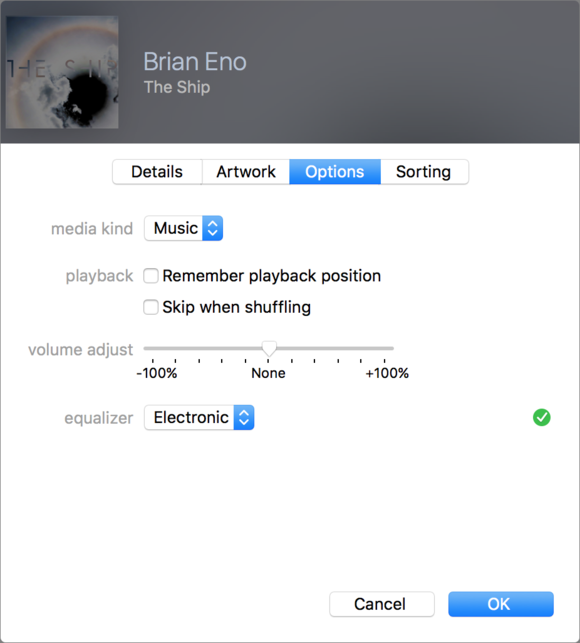
Yous tin can apply blaster presets in the Info window.
iOS devices offer equalization every bit well, using the same presets equally iTunes (Settings > Music > EQ). Here, you might be more tempted to use equalization to recoup for weaknesses in your earbuds or headphones. 1 of the most mutual uses is to increase bass since many earbuds are wimpy at the low end, only I employ EQ on my iPhone to lower the bass on my Jabra Revo Bluetooth headphones, which are a flake besides heavy in low frequencies for my gustation.
If you utilize equalization to specific songs or albums using iTunes, that setting volition override any global setting you lot've chosen in iTunes or on your iOS device. No matter how you use equalization, you demand to try out different settings and meet how they audio. You may notice distortion with some presets; I've found that some piano music distorts in high-volume sections when treble frequencies are raised, for example.
Yous might also similar to roll your ain equalizer presets. In iTunes, move the sliders to where you want, and so, from the preset menu, choose Make Preset and relieve your preset. You can only use your preset on your computer; custom presets don't get carried over to iOS devices, nor practice they get saved with your songs. They also don't get transferred with your music to another computer, then to duplicate your presets, re-create your iTunes EQ preferences (located in your user binder/Library/Preferences/com.apple tree.iTunes.eq.plist) from one Mac to some other.
Sound check
You've certainly noticed, if you listen to music in shuffle manner or in a playlist you lot've cobbled together, that some songs are louder than others. You raise the volume when a soft song comes on, only to be assaulted when the next song's volume is much higher. This is not but annoying, but information technology also doesn't audio great.
On the radio and on streaming radio services, such as Apple Music Radio, volume is normalized; the overall level of each song is adjusted so nothing is besides loud or too soft.
iTunes has a characteristic that allows you lot to normalize playback. Sound Check, in the Playback preferences, does this for you. In iOS, yous can activate Audio Check in Settings > Music.
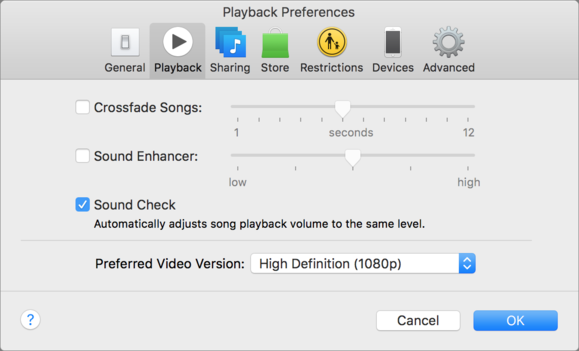
iTunes' Playback preferences offer several options for tweaking your sound, including Sound Bank check.
Check the box to activate Sound Cheque. iTunes automatically analyses your music when you add it to your library to determine how much adjustment to make. This aligning shows on the File tab of the Info window when you select a track and press Command-I.
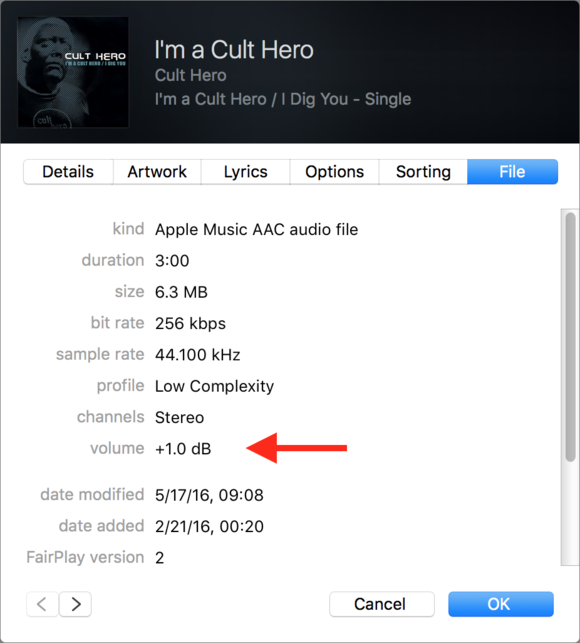
You can see how much iTunes will alter the book of a runway in the Info window.
Sound Bank check isn't perfect, though. It adjusts the volume based on the overall level of each rail, so a track with a lot of soft music followed past a loud crescendo may finish up being likewise loud, and vice versa.
Audio Enhancer
iTunes' Sound Enhancer is another way of tweaking your sound. Plant in the Playback preferences, this setting, according to Apple tree, "increases the perceived 'wideness' of the stereo effect past modifying bass and treble response." Apple too says that you tin use this to "Change the music's sound quality during playback. Drag the slider to increase or decrease the Audio Enhancer'due south effect."
What exactly the Sound Enhancer does is vague. With some music, it adds a sort of false surround audio result; simply sometimes I barely hear a difference with it turned on. There are three settings, from depression to high, and you can try it out to run into if your music sounds meliorate.
Crossfade Songs
The Crossfade feature doesn't modify the sound of the music you play in iTunes, only information technology changes the way songs are played. When you lot plough this on and choose a setting for a number of seconds, your songs overlap; they segue from i to some other. One song fades out as some other vocal fades in over the first. This isn't perfect, because some songs end or brainstorm with varying amounts of silence.
I'grand non a fan of this, but if you lot desire your music to sound more like a DJ mix, you can attempt this setting.
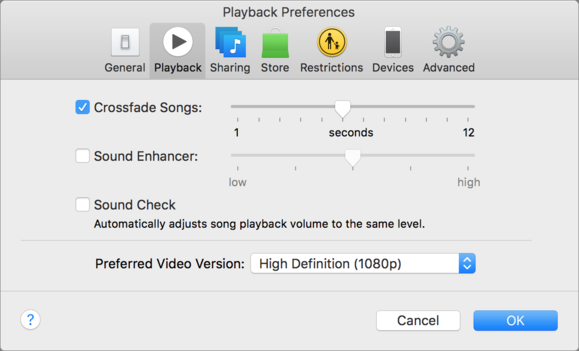
You can arrange how long your songs segue with Crossfade Songs.
Motility the slider from 1 to 12 seconds to choose the amount of fourth dimension you want the songs to overlap. Note that Crossfade Songs does not work with Apple tree Music.
These sound features tin help make your music audio better. Endeavor them out at different settings to discover what's best for you lot. Y'all may find that you want to utilize some of them, or you lot may be happy with the sound you already have.
Source: https://www.macworld.com/article/228068/how-to-tweak-your-sound-in-itunes-and-on-ios-devices.html
0 Response to "How To Make Apple Music Fade"
Post a Comment